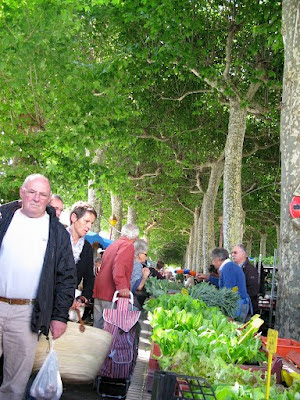
Advancement is accomplished when we have outsmarted what appears to be our only two options: to turn backwards or to drudge along forward.
The food world currently stands at this fork in the road, and we've been aware that we're twiddling our thumbs here for the last 15 years.
Genetically modified foods, such as protein-enriched rice are actually combating levels of hunger and malnutrition; agricultural pesticides, aquifer tapping for watering, and chemical additives have reduced the potentials of crop failures that once impoverished entire communities; industrial machines and factories have mitigated the need for back-breaking, dangerous labour that once claimed so many lives. And yet how can we possibly be satisfied by the products that are the champions of such processes? What is satisfying about a twinkie? What is lovely about a Dorito?
Opponents of this system first turned to the good old days. We realized the importance of local production. We applauded heritage varieties, we started to taste the flavors of the lands around us and realized how much potential our own backyards had. We recognize value in a food product by its age old definition, the actual labor that went into crafting this product, and we can taste and smell this craftsmanship in products such as beers, artiginal cheeses, or local eggs.
Le Pin is the synthesis that has fully realized our historical moment: it has embraced the best of our advancement-- technical instruments, superbly designed facilities and architecture, and scientific research-- to create a product that requires the senses and memory to be appreciated, an outcome as varied as the seasons in which it was produced, a creation that is extremely personal and with a distinct personality. It would be an understatement to say Le Pin is special.
 |
| The Pines of Le Pin seen from Le Pin's roof top terrace |
I arrived to Le Pin bright an early for my scheduled visit, which I had made with the secretary. Expecting her to greet me, it was my surprise when a Range Rover pulled up and out stepped Jacques Thienpont himself. I must admit, I did feel quite starstruck. How lucky to get a visit to the property and happen to catch a glimpse of the owner and creator of one of the world's finest vineyards…. and then, oh how lovely to get a handshake as he approached me.
Jacques Thienpont is jolly. He has the sort of face that would be easy to caricature: a linear, aquiline, distinguished nose, leading into a full, whole-hearted smile that raises his somewhat plump cheeks up until his eyes become just little crescents.
 |
| Jacques Thienpont |
"You must be Mary!," he greeted me shuffling through his car searching for something. "I can't seem to find my keys to show you in, so I'll have to pass by my cousin's place if you don't mind."
His cousin's place! This could only mean his cousin Alexandre Thienpont of Vieux Chateau Certan.
"Hop in," he gestured to the passenger seat.
Barreling through the narrow, dirt roads separating the vineyards of Le Pin, he asked "Have you visited Certan?"
When I replied in the negative he quickly suggested in his jolly tone, "Well if you have the time, we might as well have a quick visit, that way you can see this property too. Why not?"
Alexandre Thienpont answered the door to the Chateau just as any home owner would, and held the door open upon seeing the familiar face of a relative. Alexandre gives the impression of being reserved, gentle, serious, and timid, with smart eyes behind glasses that show humor and wittiness when they dart up to hold your gaze.
He handed over the keys and in a soft voice said to me, "The keys to heaven."
For Vieux Chateau Certain click here!
And so began the visit to Le Pin.
Though it likely needs no introduction, Le Pin is one of the world's renown wines. With an average bottle price of €2,000 and an average production of only 400-600 cases per year, Le Pin is certainly hard to get a hold of.
So what makes Le Pin exceptional?
 |
| Le Pin grapes the day before harvest, 2014 |
Thienpont says that 95% of making a good wine takes place outside. Located in Pomerol Le Pin is neighbor to Vieux Chateau Certan (in fact, at first the property was thought to become a part of the Certan), and the Moueix owned Chateau Trotanoy. From the small roof-top terrace of Le Pin one has a view on some pretty impressive neighbors, and of course, the two lone pine trees that symbolize the property.
The soil is mostly clay with deep gravel and sandy soil and deposits of iron oxide. Vines are nearly 100% Merlot with an average age of 35 years.
That said, the focus of our vineyard took place inside the small Chateau. The small but mighty winery was designed by Belgian architects, Robbrecht & Daem, and was recently completed in 2012.
 |
| A model of the property |
Above is pictured a model of the building. The small tower houses the secretary's office on the ground floor, and Jacques / Fiona's office on the first floor. Jacques is quick to share his love of art, design and architecture, and even while talking about wine, often illustrates his point with metaphors of art. The small room has commanding views of the vineyards stretching as far as Cheval Blanc, which can be enjoyed from some damn gorgeous leather and wood Scandanavian chairs and sofa.


One of Jacques' favorite pieces of art that commemorates the property is this black and white photograph of one of the two famous pine trees. He explained that it was photographed on a day not unlike my visit: the sky was dark and overcast, but at one point this terrific, brilliant light shot through the grayness bringing out the textures of the tree.

One theme from Le Pin: maximum quality from minimum space. This room is no different. Behind folding doors, Jacques reveals a sink and storage area that can accommodate tastings and some preparations. Other panels can pop forward, revealing a television.
The long segment of the building is the fermentation room and cellars. One enters this space from the covered out-door space between the two buildings. Here sit 7 stainless steel tanks, with coils inside (for controlling temperature) and double layers. Though each tank appears to be the same size, the inner layer varies from 15 to 40-something hectoliters to hold the wines from various plots of the vineyard. Jacques explained that this room, like all areas in Le Pin, were designed to maximize hygiene, a quality in wine production that is paramount for Fiona. Jacques says the fermentation should take place as quickly as possible, which at Le Pin is just two or three days. He explained that grapes are a natural fruit juice, just like leaving orange juice on the table for days on end, grape juice will develop unwanted flavors if the fermentation process takes too long. The temperature automatically increases during the fermentation and the vats ventilate the carbon dioxide, until there are just under two grams of sugars. Fermenation requires some air, the quantity of which varies from vintage to vintage.
 |
| Le Pin's fermentation room |


The space has the feeling of a gallery: with it's dark stone floors, and high ceilings, the room is airy and light. It feels new. Always excited to share a design feature, Jacques explained that the windows are positioned at the east and west corners of the building so that the room has two daily moments of direct sunlight and is always bright.
 |
| Jacques Thienpont points out the windows in the fermentation room |
Going down the stairs to the cellar, another window is added just above ground level to let some natural light into the cellars. In Jacques' words "Just like New York!"
The barrel room has that fresh, toasty smell of new oak. Here in 100% new french oak, the wine undergoes its malolactic fermentation, a practice which Jacques was one of the first to practice in the Right Bank. This room can be partitioned in two by sliding doors so that the temperatures can be controlled for two different vintages: the new vintage will need some heat during its second fermentation, while the last year's vintage must remain cool. Jacques noted the airiness even in this room: with the barrels close to the cool floors, the room has plenty of airspace to dissipate rising warmer temperatures.
 |
| The cellars |
When I visited in September, the day before the harvest, the room held two vintages: the 2012 had just been bottled; and the teeny-tiny 2013 filled just one tank (only 6 hectoliters, or about 800 bottles). The 2013 vintage has such low yields due to terrible storms that destroyed nearly 60% of the regions crops in the last weeks before harvest.


Above is Jacques with his favorite wine bottle size: the double magnum! For wine bottles, bigger is in fact better, as the bigger the bottle the lower the surface area exposed to that tiny gap of air in proportion to the wine, and thus better aging potentials. Please take note readers who wanted to purchase me some Le Pin: I'd prefer a double magnum.
 |
| 2012 Magnums |
As one of the world's most expensive wines, it's no surprise that many fake bottles of Le Pin have been sold in the past. To counter this, Le Pin has always been a pioneer in using the latest technology to guarantee authenticity. Currently, it is the first vineyard to use Near Field Communication (NFC), a Belgium invention. Behind the label of each bottle of Le Pin is a small chip that can be scanned with your smart phone. The phone sends a unique code to Belgium where the code matches up on the computer. He explained that it's a bit like online banking devices (we in America don't have these, but my UK bank gave me a small device that looks like a calculator into which you insert your pin, which then generates a code that can be used for online access). Jacques' explained "what's dynamic can't be copied".
Currently, Jacques is developing a new technology for the cork which would connect the cork's code to the bottle code, ensuring that a bottle has never been opened.
The last room that we entered was his cellar. Wall to wall Le Pin of every vintage!
 |
| The wine cellar at Le Pin |
Our 10am visit lasted until 1pm, at which point Jacques looked at his watch and asked what I would be doing for lunch. With generosity and kindness, he invited me to join himself and two remarkable young individuals who would be helping with the harvest (a young woman from Belgium, and a young man from the UK). "It's always lonely having to eat alone when you travel," he added.
I had arrived that morning already grateful to learn about one of the world's greatest wines, and I left brimming with appreciation. Jacques Thienpont's generosity, humility, intelligence, and passion had exceeded my expectations. He is an individual to be respected not just for his advancements in wine-making or his acute entrepreneurial skills (demonstrated by his purchase of Le Pin in 1979, and his recent purchase of L'If, as well as his negotiant company in Belgium), but he is a man of character. Humbly conversant in a range of topics from restaurants in Rome, to avant-garde art, to politics of poverty in he United States, his joy for life shone through. Clearly an advocate of lending a hand to youth, our lunch was a demonstration of the importance of "paying it forward," if you will. And he did.
Thank you, thank you, thank you, Jacques Thienpont for the visit, and to Master Sommelier Fiona Thienpont for organizing it.
Thank you, thank you, thank you, Jacques Thienpont for the visit, and to Master Sommelier Fiona Thienpont for organizing it.
Upon leaving Jacques handed me a bottle with a wink and said, "Here, share this with your friends." I'll write to you after Christmas when I return to New York where I plan to share it with my best friend, Nina.
 |
| Selfie with Jacques Thienpont |
 |
| On the roof top of Le Pin with the pines themselves! Thank you Jacques! |