Today I was invited to visit the house of Sylvie.
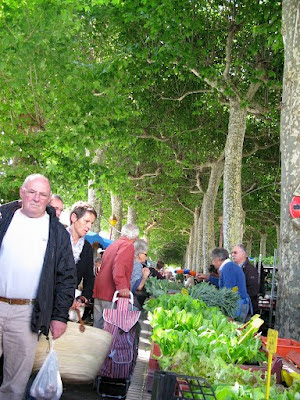
Sylvie lives in one of the many teeny villages in the hills surrounding Saint Girons. Saint Girons may be the central town, but these hills give the region its character and flavor. On Saturday, Saint Girons is home to one of France's most vibrant markets, in which the thousands of cheeses, produce, sweets, and meats journey from their small houses of production in the mountains down to the banks of the Salat to be sold. Here, market-browsers have the rare opportunity of purchasing some of France's best products-- but also some of the most difficult to attain outside of the Ariege.
At these markets, a visitor would have a taste not only of the outstanding products, but also of the people who produce them. If I may say so, Ariégeois are an uncommon bunch. Friendly, alternative, and remarkably happy, they are people with such humility and a contagious appreciation for life. In their company one cannot help but lean back, breathe deeply, gaze at the mountains, and feel a joy emanating from within. A visitor to the Ariege will undoubtedly note the predominance of a "free" lifestyle here. Though traditional and conservative dress will still be found, at the market you are more likely to encounter dread-locks, whispy long skirts, breezy linen shirts, hand-rolled cigarettes, and jewelry made of nature. You may hear a guitar being plucked, you may see a bare-foot couple spontaneously start dancing, and you may be even hesitant to accept the beautiful white goat cheese from the soil-stained hands of the older farmer.
Because these hill villages, frequently with less than one-hundred inhabitants, are often reached only by curving, country roads, they can be impossible to discover for the average tourists. From Saint Girons or Saint Lizier, I would gaze into these picturesque hills and Mountains further in the distance and dream about what life must be like in this most stunning environment.
Today I had the opportunity to find out.
We followed a narrow road from Hotel Eychenne, exiting the little town, and entering a land of wide planes, circular hay bales on fields perfumed of freshly cut grass. And suddenly the greens of the scenery became more vibrant. The low hills appeared near in sight, with small fields carved out of the thick forests for grazing animals. In the distance, powerful and noble, stood the peaks of the Pyrenees, some of them still white from this year's heavy snowfall.
After about fifteen minutes of whipping around these little hills, following streams, and peering into small villages with old Roman stone churches, we arrived at the most pleasant village.
Sylvie smiled at me, and said "Not quite yet, I live up."
She pointed to a narrow stone road, leading into one of these small, voluptuous hills. The car bumped along the gravel, groaning with the ascent.
And there, after passing through a stand of Birch trees, the ground lined with early-summer ferns, we saw a clearing and a small stone house.
Hens cackled about, a rooster crowed, and a strong wind blew the tall grasses surrounding the house, revealing flashes of color from the wild flowers. The house, with it's triangular metal roof, complemented it's background of the snow-caped Pyrenees. A writing desk and wooden chair sat silently under the shade of a large oak tree, facing a field of wheat and flowers and the mountains. Water from a spring babbled in the distance. Birds sat for a moment to share their songs on the solar panels. And the outhouse had a view of a birch grove where foxes played in the early morning.
Inside of the house Sylve's husband had build everything: the floors, the ceilings, the cabinets and the bookshelves were hand-built or carved from wood. With few straight lines in sight, the counters around the kitchen curved, making natural stations for a cook to work in an intimate enclave. Art books-- from Ingres to modern photography-- curved around the walls, leading the way from the sunny sitting room, walls entirely composed of glass, to the shadowy den, preserved from the summer's sun.
We ate on a table, beside the vegetable garden and admits the clucking hens, which provided our meal. We drank water from the mountain stream that sang for us. We looked onto the fields in the distance on which the goats graze whose milk had been turned into our cheeses. With satisfaction, I felt the wind blow against my skin after it grazed the daisies and buttercups in the fields, and I felt joyful.
Merci, Sylvie!